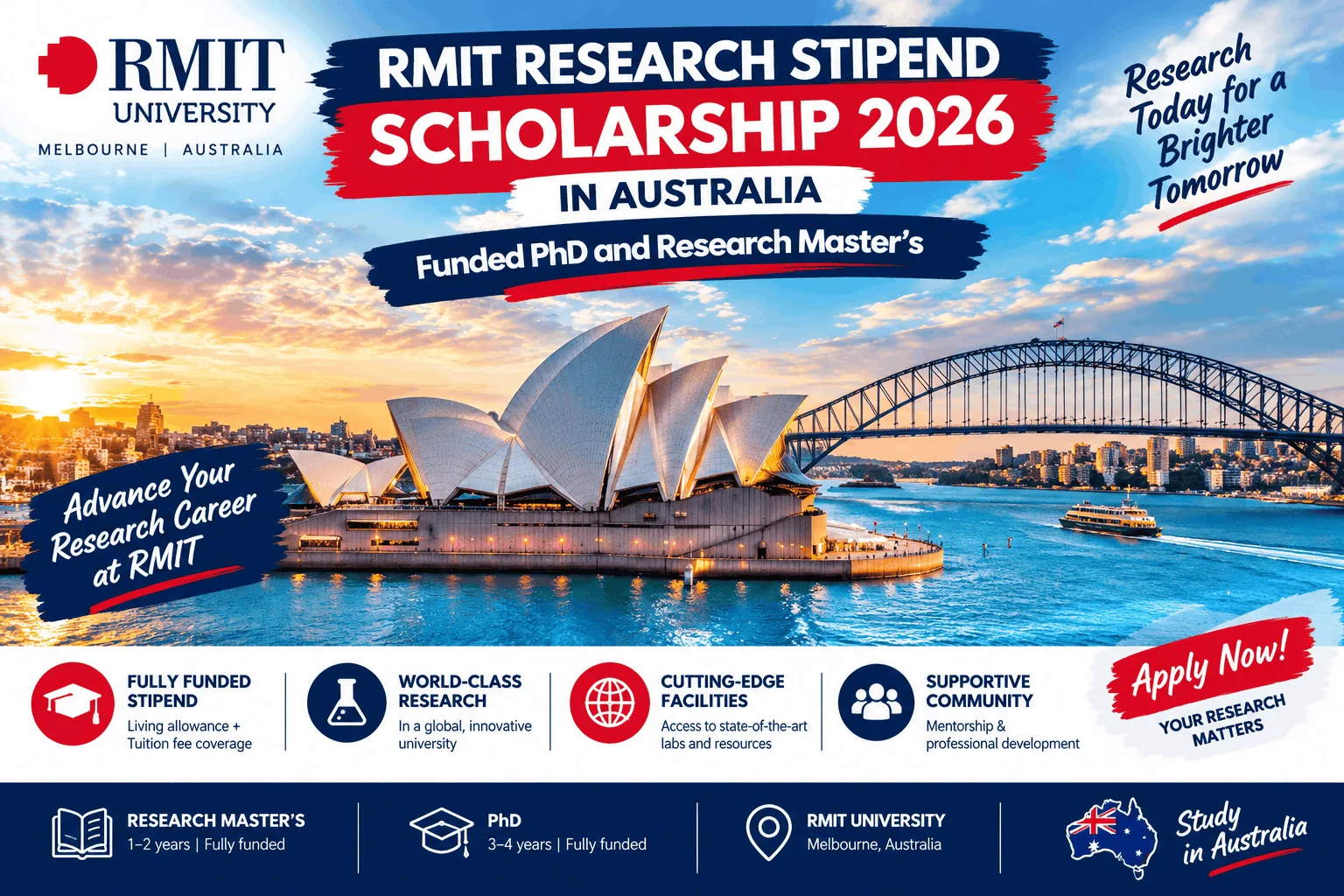
RMIT Research Stipend Scholarship 2026 in Australia: Funded PhD and Research Master's
- Country
- Australia
- Level
- PhD, Masters, Research
- Funding
- Fully funded
The RMIT Research Stipend Scholarship is one of the more genuinely strong awards in this field, and unlike many "fully funded" listings, the label mostly holds up: a successful recipient typically gets a living stipend and tuition covered to pursue a PhD or research master's at RMIT in Melbourne. But it works like a research funding round, not a simple application form, and one step, securing a supervisor, decides more than anything else. This is the detailed version, including exactly what you get, a full Melbourne budget, how the application really works, and the mistakes that cost people funding.
What you get
For 2026, the package is built around three things:
- A stipend of AUD 36,245 per year (pro rata for full-time study), indexed annually.
- A tuition fee offset: local candidates receive an RTP Fee Offset, and international recipients receive an RTP International Tuition Fee Offset or an RMIT Research International Tuition Fee Scholarship.
- A relocation allowance of up to AUD 1,540, plus paid leave provisions.
Research stipends of this kind in Australia are generally tax-free, so the real value of AUD 36,245 is higher than it looks against a taxed salary. Combined with tuition cover, that is why this award is close to full funding for research students, including internationals. It is a genuine, substantial package rather than a token contribution, which is exactly why it is competitive.
The one step that decides your application: a supervisor
This is the part that catches people out. The application is an expression of interest that must include evidence of contact with a proposed senior supervisor. Research funding at RMIT attaches to a supervisor and a project, so a professor who is willing to supervise you, and who sees your research as a fit, is often what turns an expression of interest into an offer. The real work therefore starts before the form:
- Identify RMIT researchers whose work overlaps with yours, by reading recent publications and lab or group pages.
- Email a specific, genuine message introducing yourself, your best result or experience, and a concrete research idea that connects to their work.
- Secure their support so your expression of interest names an engaged supervisor who wants you in their group.
Do this first, and the rest of the application has a foundation. Skip it, and a strong academic record alone often is not enough, because the funding follows the supervisor and the project.
Who can apply
- Applicants for a Higher Degree by Research at RMIT: a PhD or a Masters by Research.
- A strong academic record, typically high distinction (around 80 percent or above) in the final two years of a qualifying program, or equivalent.
- International students who meet the English-language requirements.
- Applicants with enough time remaining in candidature (around 24 months for a PhD, 12 months for a Masters by Research).
Note that you generally cannot already hold an equivalent research qualification or another Commonwealth-funded research scholarship, so check the exclusions before applying.
How long it runs
- PhD: three and a half years full-time.
- Masters by Research: two years full-time, with no extension option.
Plan your research scope to fit these windows, since the Masters by Research in particular is firmly time-boxed and does not allow extensions. A realistic, well-scoped project is part of a convincing application.
A worked budget: living in Melbourne on the stipend
Melbourne is a major, high-quality city, and it is not cheap, with rent the biggest expense. Here is the honest shape of a monthly budget for a single research student, with tuition already covered by the scholarship:
- Stipend: AUD 36,245 per year is roughly AUD 3,000 per month, and because it is generally tax-free, you keep it all.
- Rent: a room in a shared place is the realistic option; a whole apartment is far more. Expect rent to be your largest single cost.
- Food, transport, and essentials: manageable on the stipend, helped by student transport concessions and cooking at home.
- Overseas Student Health Cover (international students): a required cost you must budget for across your candidature.
- Setup costs on arrival: bond or deposit, initial furnishings, and the gap before your first stipend payment.
The honest conclusion: on a tax-free stipend of around AUD 3,000 per month with tuition covered, a single researcher lives comfortably in Melbourne, especially sharing accommodation, and the relocation allowance softens the move. Budget carefully for your first month and for health cover, and the funding genuinely works. Bringing dependents stretches it, so plan for that separately.
What a strong expression of interest looks like
Because the award is research-based, your expression of interest should read like a researcher's pitch, not a scholarship essay:
- A named supervisor and evidence of contact, showing the fit is real.
- A focused research proposal or idea that connects to that supervisor's work and is feasible in the time available.
- Evidence of your research ability: relevant projects, methods, a strong thesis or results, and any publications.
- Clear academic standing demonstrating the high-distinction requirement.
Tailor everything to the specific group and project. A generic application, however strong academically, competes poorly against one that clearly belongs to a particular lab.
Common reasons applicants miss out
- Applying without a supervisor. The expression of interest expects evidence of supervisor contact; without it, you are at a serious disadvantage.
- A vague or oversized project. Proposals that cannot be done in the candidature window, or that are not specific, lose to focused ones.
- Missing the candidature-time rule. You need enough time remaining in your degree to qualify.
- Weak alignment. Excellent candidates in the wrong subfield lose to good candidates who fit the supervisor's work.
- Late applications. RMIT runs rounds; being prepared to apply when a round opens matters.
A realistic timeline
- Three to four months before a round: identify target supervisors, read their work, and prepare a strong CV and a draft research idea.
- Two months before: email supervisors with specific messages and refine your proposal based on replies.
- When a round opens: submit your expression of interest promptly, with supervisor-contact evidence.
- After submitting: respond quickly to any interview or document requests.
- On an offer: allow time for admission and, if international, the student visa, Overseas Student Health Cover, and relocation.
How it compares to other Australian research funding
It helps to see the RMIT Research Stipend Scholarship within Australia's wider system, so you can target the right thing:
- The Research Training Program (RTP) is the Australian Government scheme that funds much domestic and international research study, and RMIT's stipend sits within this framework. Most Australian universities run their own RTP-based stipend and fee-offset scholarships at broadly comparable rates (the national stipend rate is similar across institutions and indexed each year), so the RMIT award is competitive with, not unusually different from, equivalents at other Australian universities.
- University-specific top-up and vice-chancellor's scholarships sometimes add to the base stipend for outstanding candidates, so it is worth asking whether RMIT or your supervisor has any top-ups available for your project.
- Australia Awards are a separate, government-funded route aimed at applicants from specific developing countries, covering a broader package, and worth checking if you are from an eligible nation.
The practical point: the mechanics (stipend plus tuition offset, tied to a supervisor, via an RTP-style scheme) are similar across Australia, so choose based on the supervisor and project fit, which is what really decides your success, rather than chasing a marginally higher headline stipend elsewhere.
Is this right for you?
Choose this if you want a genuinely well-funded research degree, you can secure a supervisor, and you are ready to compete in a round rather than fill in a simple form. It is less suited to someone who wants coursework rather than research, who cannot commit to a multi-year project, or who needs to start immediately without a supervisor in place. If you fit the research profile, this is one of the stronger funded routes into Australia.
How to apply, step by step
- Contact and secure a senior supervisor at RMIT whose research fits yours.
- Prepare your expression of interest, including evidence of that supervisor contact and a focused proposal.
- Gather your academic evidence showing the required high distinction or equivalent.
- Submit within the current scholarship round, since RMIT runs rounds rather than one annual deadline.
- Complete admission and, if international, visa and health-cover steps once offered.
After your degree
A funded PhD or research master's at RMIT is strong research experience at a well-regarded Australian university, building publications, skills, and an international network. Australia offers post-study pathways for graduates and researchers, subject to current immigration rules, and RMIT's industry links support careers in both academia and industry. Many research graduates move into postdoctoral roles or industry research from here, and a funded Australian research degree is a credential that travels well internationally.
Apply and confirm the details
Check the current stipend rate, tuition cover, eligibility, and round deadlines, and apply, on the official RMIT research scholarships pages: RMIT Research Stipend Scholarships, official site.
Explore more opportunities: browse all our scholarships, prepare for admission with our free IELTS and English prep, or learn how we verify every opportunity.
Disclaimer: OurScholarships is an independent information platform and is not affiliated with or endorsed by RMIT University. Rates and rules change, so always confirm on the official source before applying.
Frequently asked questions
How much does the RMIT Research Stipend Scholarship pay?
For 2026 the stipend is AUD 36,245 per year (pro rata for full-time study), indexed annually, and it comes with a tuition fee offset and a relocation allowance of up to AUD 1,540. Research stipends of this type in Australia are generally tax-free, which makes the real value higher than the headline figure suggests. Always confirm the current rate in the scholarship round.
Does it cover tuition for international students?
Yes, in most cases. Local candidates receive an RTP Fee Offset covering tuition, and international recipients get either an RTP International Tuition Fee Offset or an RMIT Research International Tuition Fee Scholarship. So a successful international applicant typically has both a living stipend and tuition covered, which is why this is close to full funding for research study.
Who is eligible?
Applicants aiming for a Higher Degree by Research (a PhD or a Masters by Research) at RMIT, who have achieved high distinction (around 80 percent or above) in the final two years of a qualifying program or equivalent. International students are eligible if they meet the English requirements. You also need enough time remaining in your candidature (around 24 months for PhD, 12 for Masters).
How do you apply?
You submit an expression of interest that includes evidence of contact with a proposed senior supervisor, because research funding at RMIT is tied to a supervisor and project. There is no single national deadline; RMIT runs scholarship rounds, so check the current round dates and secure supervisor support before applying.
Is the stipend enough to live on in Melbourne?
Yes, comfortably for a single student, especially sharing accommodation, because the stipend is tax-free and tuition is covered separately. Melbourne is a high-quality but not cheap city, with rent the main expense. The relocation allowance helps with the move, and international students should also budget for Overseas Student Health Cover and initial setup costs on arrival.
Can my family come with me?
International PhD students in Australia can often bring dependents on the relevant visa, but the scholarship stipend is set for one researcher and is not increased for a family. If you plan to bring dependents, budget carefully, since the stipend will need to stretch further and partner work rights and schooling costs vary. Confirm current visa and work conditions before relying on a partner's income.