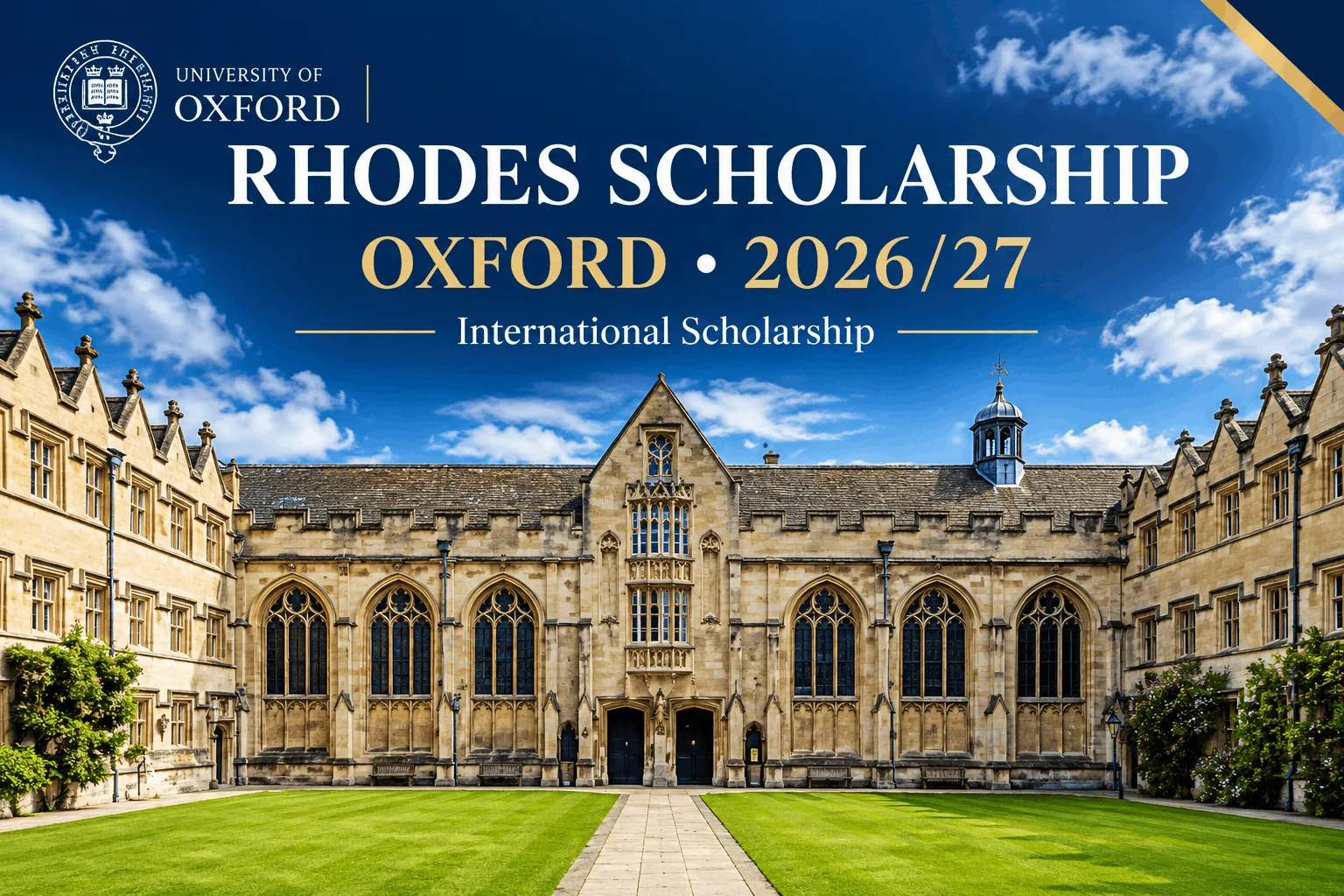
Rhodes Scholarship 2027 at Oxford: What It Really Takes to Win the World's Oldest Scholarship
- Country
- UK
- Level
- Masters, PhD
- Funding
- Fully funded
The Rhodes Scholarship is the oldest and arguably most prestigious international scholarship in the world, and understanding it properly means understanding that it is not really a funding competition. It is a leadership selection that happens to come with full funding to Oxford. Thousands of academically brilliant people apply each year; a small number win, and the difference is rarely grades. This guide is an honest, detailed look at what the scholarship covers, how the constituency system works, who actually gets in, and how to give yourself a real chance.
Why Rhodes is a leadership contest, not just a scholarship
Cecil Rhodes established the scholarship to develop public-spirited leaders, and that mission still drives selection more than a century later. The Rhodes Trust is not simply looking for the highest marks; it is looking for people who combine intellectual excellence with character, leadership, and a genuine commitment to service, people it believes will go on to make a difference in the world. This matters enormously for your application, because it means a flawless transcript alone will not win. Evidence that you have led, served, and shown integrity is what distinguishes the tiny number of scholars from the very large number of excellent applicants.
What "fully funded" actually means here
Rhodes earns the label honestly. The scholarship provides:
- All University of Oxford course and college fees, in full.
- An annual living stipend of around £20,400 (for 2025/26), from which you pay accommodation and living costs, roughly £1,700 a month.
- Your student visa fee and the Immigration Health Surcharge, giving you access to the UK's NHS.
- Two economy-class flights to and from the UK, at the start and end of your studies.
- A settling-in allowance on arrival.
Funding runs for two years and can extend to a third for those pursuing a DPhil (Oxford's PhD). The one honest limitation: the stipend is set for the scholar alone and is not enough to support a partner or children, so plan accordingly if you have dependents.
The constituency system: your first and most important step
Here is the structural point that confuses many applicants. You do not apply to "Rhodes" in general; you apply through a specific constituency, a country or region, whose citizenship and residency requirements you meet. Each constituency has its own eligibility rules, its own deadline, and its own selection committee. Rhodes has constituencies for many countries, and if your country does not have one, you may be eligible for the Global Rhodes Scholarship.
So your first task, before anything else, is to identify your constituency on the official Rhodes website and read its specific criteria carefully. The age limits, residency rules, and deadlines that apply to you are the ones on your constituency's page, not a generic version. Getting this right at the start saves you from preparing against the wrong rules.
Who gets in: beyond the grades
Successful Rhodes Scholars tend to share a recognisable profile:
- Academic excellence at a First Class Honours standard, as the baseline rather than the differentiator.
- Real leadership, shown through something you built, led, or changed, with a tangible result, not just titles held.
- Character and integrity, which the Trust weighs heavily and which comes through in references and interview.
- A commitment to service, a sense that you intend to use your talents for others, not only yourself.
- Energy and the drive to use your abilities to the full, a quality written into the original criteria.
If your profile is strong grades with little evidence of leadership or service, you are a weaker candidate than someone with slightly lower marks and a genuine record of impact. Build and tell that record honestly.
The two things you must win: the scholarship and Oxford admission
A crucial practical point: winning the Rhodes does not admit you to Oxford. You must gain admission to your chosen Oxford postgraduate course through the university's own competitive process, and separately win the scholarship. You run both applications in parallel, and you need both to succeed. This means choosing an Oxford course you are genuinely competitive for, preparing a strong Oxford application, and meeting Oxford's own deadlines alongside the Rhodes deadline. Treat them as two linked tasks, not one.
The selection process and interview
Rhodes selection is rigorous. After you submit your application through your constituency, the process typically involves shortlisting based on your record, references, and personal statement, followed by a demanding interview, often including a social event and a formal panel interview. The interview is decisive and is where committees test not just what you have done but how you think, how you handle pressure, and whether your commitment to service and leadership is genuine. Prepare by being able to discuss your work, your field, current issues, and your motivations clearly and honestly, and practise with people who will challenge you rather than flatter you.
A realistic preparation timeline
Because Rhodes rewards depth, start early:
- A year or more out: build and deepen genuine leadership and service, since you cannot manufacture this at the last minute.
- Four to six months before the deadline: identify your constituency and your Oxford course, and line up referees who can speak to leadership, character, and service.
- Three months before: draft your personal statement and prepare your Oxford application in parallel.
- Two months before: get honest feedback and rewrite, and sit any required tests.
- Before the deadline: submit both your Rhodes and Oxford applications, confirming both sets of requirements.
- If shortlisted: prepare thoroughly for the interview with mock panels.
A worked note on living in Oxford
The stipend of around £20,400 a year is designed to cover a single scholar's living in Oxford, a city where accommodation is the main cost. Many Rhodes Scholars live in college accommodation, which simplifies budgeting, and the stipend comfortably supports a full student life, though Oxford is not cheap. Keep a small buffer for your first weeks, before the stipend settles and while you set up, and remember the award does not stretch to supporting dependents.
Common mistakes to avoid
- Treating it as a grades competition. Leadership, character, and service are what decide it.
- Ignoring the constituency rules. Your eligibility and deadline are constituency-specific; read your own.
- Forgetting the Oxford application. You must gain admission separately, so do not neglect it.
- A generic personal statement. Committees read thousands; specificity and authenticity stand out.
- Betting everything on Rhodes. It is tiny and selective, so apply to other options too.
Is Rhodes right for you?
Pursue the Rhodes if you have a genuine record of leadership and service alongside academic excellence, you can be competitive for Oxford admission, and you meet your constituency's criteria. It is less suited to someone whose strength is grades alone, or who cannot commit to the demanding, multi-stage process. If you fit the profile, it is one of the great opportunities in the world; if you do not yet, it may be a goal to build toward while you pursue other funded routes now.
After Rhodes
Rhodes Scholars join a global network of alumni across government, academia, business, medicine, law, and public service, and the scholarship opens doors for a lifetime. The combination of an Oxford degree, the Rhodes name, and that network is a powerful launchpad, but the Trust's hope is simpler: that scholars use their education in the service of others. The strongest applicants understand that from the start and can say, honestly, what they intend to do with the opportunity.
How Rhodes compares to other top UK and global scholarships
Rhodes is not the only elite fully funded route, and the strongest applicants apply to several that fit them, since each is highly selective:
- The Marshall Scholarship funds US citizens to study in the UK, with a similar leadership ethos but a different national focus.
- Gates Cambridge funds postgraduate study at Cambridge for applicants worldwide, comparably prestigious and comparably hard to win.
- The Clarendon Scholarship is Oxford's own large, merit-based fund, and applying to Oxford automatically considers you for it, so a Rhodes applicant is often in the Clarendon pool too.
- Chevening funds master's study in the UK for applicants from many countries, with a focus on future leaders and a one-year master's.
The practical takeaway: treat Rhodes as one of several top-tier options rather than your only plan. Because you must gain Oxford admission anyway, you are often automatically considered for Clarendon, and strong candidates frequently apply to Rhodes, Gates Cambridge, and Chevening in parallel, tailoring each to that programme's specific mission. Applying broadly, while giving each application genuine care, is simply realistic given how few places exist.
A final word on honesty with yourself
Rhodes rewards a rare combination, and part of preparing well is being honest about where you stand. If you have the academic record but have not yet built a genuine leadership and service story, the most useful thing you can do is build that now, through real work that matters to you, rather than trying to dress up a thin record for a committee that reads thousands of applications and sees through it. Many successful scholars applied more than once, or applied after a year or two of meaningful work. Treat the Rhodes as a goal to grow toward, keep pursuing other funded routes in the meantime, and let your record become genuinely strong rather than merely polished.
Apply and confirm the details
Find your constituency, read the full criteria, and apply, on the official Rhodes Trust website: The Rhodes Scholarship, Rhodes Trust.
Explore more opportunities: browse all our scholarships, prepare for admission with our free IELTS and English prep, or learn how we verify every opportunity.
Disclaimer: OurScholarships is an independent information platform and is not affiliated with or endorsed by the Rhodes Trust or the University of Oxford. Details vary by constituency and change each year, so always confirm on the official source before applying.
Frequently asked questions
Is the Rhodes Scholarship fully funded?
Yes, genuinely. It covers all University of Oxford course and college fees, plus an annual living stipend (around £20,400 for 2025/26), from which you pay accommodation and living costs. It also covers your student visa and the health surcharge (giving NHS access), two economy flights to and from the UK, and a settling-in allowance. One honest caveat: the stipend supports the scholar, not partners or dependents.
Who can apply, and can students from my country apply?
You apply through the Rhodes constituency (a country or region) whose citizenship and residency rules you meet. Rhodes has constituencies for many countries, including Australia, Canada, China, India, Kenya, Pakistan, Singapore, the United States, and various African, Caribbean, and Middle Eastern regions. If your country has no constituency, you may be eligible for the Global Rhodes Scholarship. Always check the official constituency list for your situation.
What are the age and academic requirements?
Age limits are usually 18 to 24 as of 1 October of the entry year, with some variation (for example 18 to 25 for medicine, dentistry, law, or engineering, and up to 27 for those who finished their undergraduate degree more recently). Academically you need an outstanding record, typically at a First Class Honours standard, and you must complete a bachelor's degree before starting at Oxford.
Does winning Rhodes get me into Oxford automatically?
No, and this trips people up. You must win the scholarship and separately gain admission to your chosen Oxford course through the university's own competitive process. The Rhodes covers the funding; Oxford admissions decides whether you have a place. You need both, so you run two applications in parallel.
How competitive is it?
Extremely. Rhodes selects a small number of scholars per constituency from very strong applicant pools, so even outstanding candidates are often not chosen. It rewards a rare combination of academic excellence, leadership, character, and commitment to service, and the final interview is rigorous. Apply with ambition, but also pursue other options, because the numbers are humbling.
When is the deadline?
Deadlines are set per constituency and typically fall around July to October for study starting the following October. Because dates, age limits, and criteria differ by constituency and change each year, always confirm the exact deadline on your constituency's page on the official Rhodes Trust website.