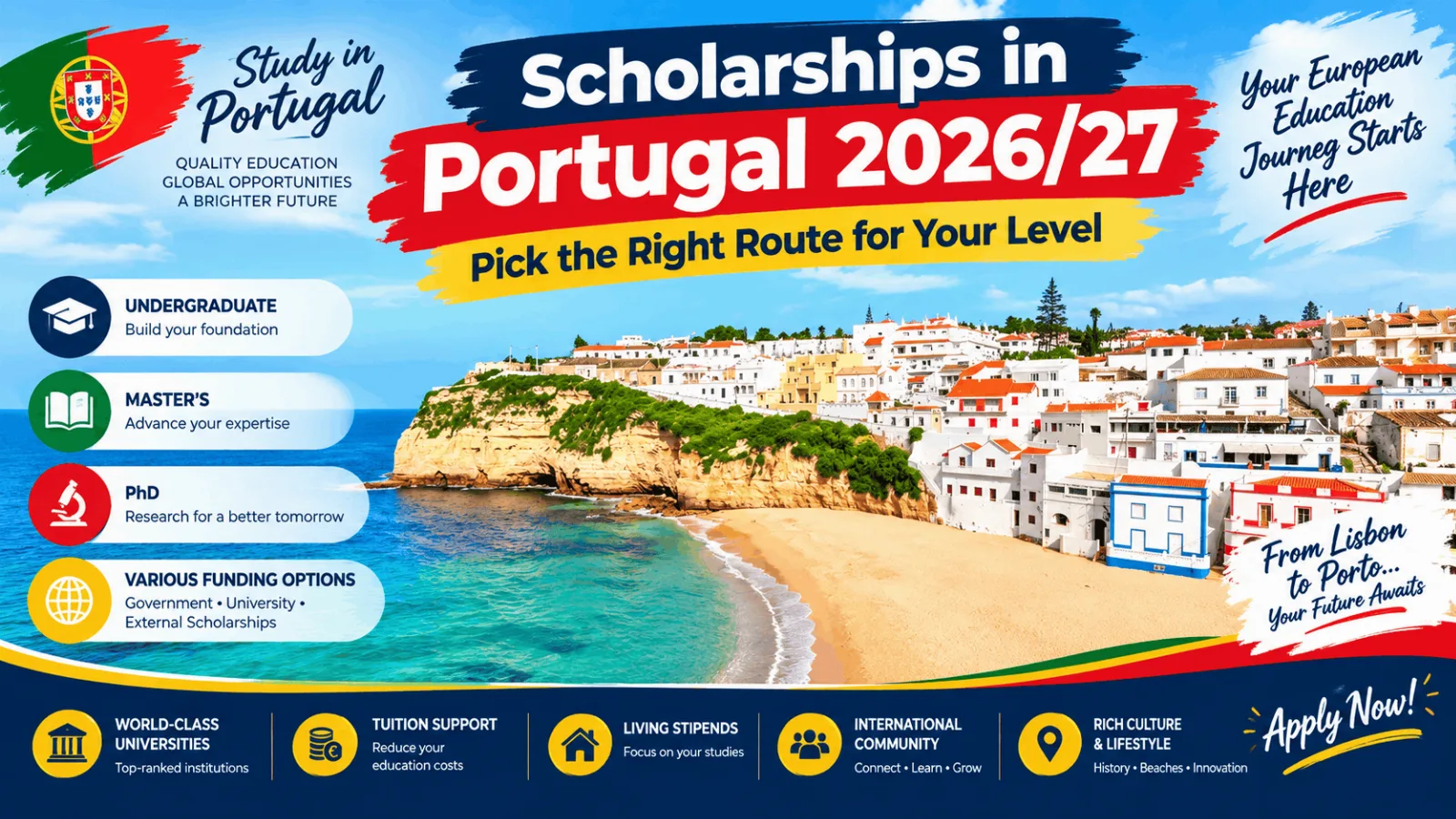
Scholarships in Portugal 2026/27: Pick the Right Route for Your Level
- Country
- Portugal
- Level
- Masters, PhD
- Funding
- Fully funded
The reason most people struggle to fund study in Portugal is that they look for the wrong thing: a single national scholarship. There isn't one. What exists is a handful of very different routes, and which one is right for you is decided almost entirely by your level of study. Get that match right and funding becomes realistic, helped by the fact that Portugal is one of Europe's more affordable countries. This guide is organised the way you should actually think about it: by route.
First, a scholarship myth worth clearing up
You will almost certainly see pages advertising a single "Portugal Government Scholarship" that is fully funded for every international student, at every level, with a fixed monthly stipend and one neat deadline. Treat those with real caution. Portugal's official higher-education authority, the Directorate-General for Higher Education (DGES), does not describe one blanket fully funded scholarship for international students covering undergraduate, master's, and PhD study. The DGES-administered study grants (bolsas de estudo) are need-based and aimed mainly at domestic and EU students, and other financial support varies from one university to another. In other words, there is no single government cheque waiting for all international applicants. The routes below are the ones that are real, verifiable, and worth your time, so build your plan around these rather than a scholarship that cannot be confirmed on an official source.
Then pick your route by level
Before anything else, locate yourself:
- Doing a PhD or research? Your main target is an FCT doctoral grant.
- Doing a master's? Look at Erasmus Mundus Joint Masters and university merit scholarships.
- From a Portuguese-speaking or partner country? Also check Camoes Institute bilateral programmes.
- An EU student on a low income? DGES social support is a need-based option.
Everything below expands on these, so you can go straight to the one that fits.
For PhD researchers: FCT grants
The Foundation for Science and Technology (FCT) runs Portugal's main research funding, and its doctoral grants are the closest thing to full funding for research students. A grant provides a stipend of around 1,260 euros per month, plus social-security coverage and tuition support. Because it is research-focused, your application rests on a strong, feasible research proposal and, in most cases, a host institution and supervisor who back your project. If you are heading into a PhD, build your plan around FCT: identify a supervisor, shape a proposal together, and apply through the FCT process.
For master's students: Erasmus Mundus and university awards
Master's funding runs on two tracks. Erasmus Mundus Joint Masters are prestigious, fully funded programmes that cover tuition and provide a monthly stipend of around 1,400 euros; they often involve studying in more than one country, with Portuguese universities as partners, and you apply to the specific programme consortium. University merit scholarships come from institutions such as Lisbon, NOVA, Porto, and Coimbra; some reduce tuition partially, others cover it fully for exceptional applicants, and they usually align with admission deadlines. A strong strategy is to apply for admission with scholarships in mind and to shortlist relevant Erasmus Mundus programmes in parallel.
For specific nationalities: Camoes and bilateral programmes
Portugal's cultural cooperation agency, the Camoes Institute, funds international students, especially from Portuguese-speaking nations and countries with bilateral agreements. These programmes can cover tuition (propinas) and provide a monthly living stipend for degree study or research. If you are from an eligible country, this is a route worth checking early, as it can be more accessible than the open-competition awards.
Where you can study, and what each university is known for
Scholarships and funded places exist across Portugal's public universities, and choosing the right one matters as much as the funding, because each has its own strengths and its own scholarship and admission procedures:
- University of Lisbon, the largest, with a very wide range of programmes and particular strength in the arts, humanities, and social sciences.
- University of Porto, a leader in engineering and technology with strong research facilities.
- University of Coimbra, one of Europe's oldest universities, known for law and medicine.
- NOVA University Lisbon, well regarded for business and economics (its NOVA SBE school in particular).
- University of Aveiro, strong in materials science and technology, with close industry partnerships.
Because each institution runs its own admissions and funding, confirm the specific requirements, deadlines, and documents on your chosen university's own pages rather than assuming a single national process.
Language requirements you'll need to meet
A detail that catches people out: you usually need to prove language proficiency, and which language depends on how your programme is taught. For Portuguese-taught programmes you generally need around B2-level Portuguese, and for English-taught programmes around B2-level English. A formal test like IELTS is often not mandatory, and acceptable proof can include a previous degree completed in that language, a recognised proficiency certificate, or a university-administered test. Check your programme's exact requirement early, since arranging proof can take time.
Why Portugal's low costs change the math
Here is something that works in your favour and that most guides underplay. Because Portugal is affordable, you do not always need full funding to make study work. A partial university award, or a fee reduction combined with modest savings, can be enough in a way that would be impossible in a high-cost country. So when you weigh options, factor in the low cost base, not just the headline value of each scholarship.
What you'll actually pay to study and live
Non-EU tuition commonly ranges from around 3,000 to 7,000 euros per year, while EU tuition can start much lower. On living costs, a student needs a reasonable monthly budget for accommodation, food, transport, and personal expenses, with Porto and Coimbra generally cheaper than Lisbon. Build your plan around the specific city you will study in, since rent is the biggest variable.
How to apply, by route
- FCT doctoral grant: secure a supervisor and host, prepare a research proposal, and apply through the FCT process.
- Erasmus Mundus: choose your joint master's programme and apply to its consortium, following its own requirements.
- University scholarship: apply to the university, usually alongside admission, and flag your interest in funding.
- Camoes programme: apply through the Camoes Institute if you are from an eligible country.
In all cases, prepare transcripts, references, language certificates, and (for research) a proposal, and keep each scheme's own deadline.
A timeline across the different schemes
Because the routes run on different calendars, work backwards from each deadline rather than treating them as one. Research-grant and Erasmus Mundus deadlines in particular can fall early, often months before study begins, so start a PhD proposal or a joint-master's shortlist well ahead. University scholarships typically track admission dates. Mapping all your target deadlines on one calendar early is the single best way to avoid missing a route.
Mistakes that waste a Portugal application
- Hunting for one national scholarship. Choose a route by level instead.
- Applying through the wrong channel. FCT, consortia, universities, and Camoes each have their own process.
- Underusing Portugal's low costs. A partial award can be enough here, so do not dismiss them.
- Missing early deadlines. Research and Erasmus Mundus dates can be surprisingly early.
Working while you study
Money does not have to come only from a scholarship. International students in Portugal can typically work part-time, commonly up to around 20 hours per week during term, which can meaningfully supplement a partial award given the country's low cost of living. Treat part-time work as a top-up rather than a plan to fund your whole degree, and check the current work rules tied to your student visa or residence permit, since conditions can change and differ for non-EU students.
A realistic plan across the routes
Because Portugal has no single scholarship, the winning strategy is to work several routes in parallel and on the right calendar:
- If you are heading for a PhD: make FCT your main target, secure a supervisor and host institution early, and build a strong, feasible research proposal, since this is the closest to full funding.
- If you are heading for a master's: shortlist relevant Erasmus Mundus Joint Masters (fully funded, applied to via each consortium) and, in parallel, apply to Portuguese universities flagging interest in merit scholarships.
- If you are from a Portuguese-speaking or partner country: check Camoes Institute programmes early, as they can be more accessible than open competitions.
- Throughout: map every target deadline on one calendar, because research-grant and consortium deadlines often fall months before study begins.
Working routes in parallel, rather than betting on one, is how international students actually get funded for Portugal, and the country's low costs mean even a partial award can be enough.
After you graduate
A Portuguese degree is recognised across the European Union and beyond, and studying in Portugal gives you European experience, an international network, and often new language skills. The EU offers routes for graduates and researchers to stay for further study or work after a programme, subject to current immigration rules, and Portugal's growing economy and research sector provide opportunities for those who wish to remain. Learning some Portuguese during your studies is a genuine career asset, both locally and across Portuguese-speaking markets.
Apply and confirm the details
Check the current grants, eligibility, and deadlines, and apply, through the official Portuguese funding and study pages: FCT (Foundation for Science and Technology), official site and the Camoes Institute, official site.
Explore more opportunities: browse all our scholarships, prepare for admission with our free IELTS and English prep, or learn how we verify every opportunity.
Disclaimer: OurScholarships is an independent information platform and is not affiliated with or endorsed by any Portuguese government body or university. Details change each year and vary by scheme, so always confirm on the official source before applying.
Frequently asked questions
Is there one main scholarship for studying in Portugal?
No, and that is the key thing to grasp. The right funding depends on your level. PhD researchers aim for FCT doctoral grants, master's students aim for Erasmus Mundus Joint Masters and university merit scholarships, and students from certain countries can look at Camoes Institute bilateral programmes. Trying to apply for 'a Portugal scholarship' in general is the most common mistake.
What does an FCT doctoral grant pay?
FCT doctoral grants support research-focused PhD (and some master's) candidates with a stipend of around 1,260 euros per month, plus social-security coverage and tuition support. For PhD study, this is the closest to full funding and the strongest route into funded doctoral research in Portugal.
How much does it cost to study and live in Portugal?
Portugal is affordable by European standards. Non-EU tuition commonly ranges from around 3,000 to 7,000 euros per year, while EU tuition (propinas) can start much lower. Living costs are modest, with Porto and Coimbra generally cheaper than Lisbon, which means even a partial scholarship plus savings can make study realistic.
Does Erasmus Mundus include Portugal?
Yes. Erasmus Mundus Joint Masters are fully funded programmes (covering tuition and providing a monthly stipend of around 1,400 euros) that often span more than one country, with Portuguese universities as partners in many of them. You apply to the specific joint programme consortium rather than to Portugal directly.
Can I work part-time while studying in Portugal?
Generally yes. International students in Portugal can usually work part-time, commonly up to around 20 hours per week during term, which can top up a partial scholarship given the low cost of living. Rules are tied to your student visa or residence permit and can differ for non-EU students, so confirm the current conditions before relying on work income.
Is there a single fully funded Portugal Government Scholarship for all international students?
Not according to the official source. Many blogs advertise one blanket fully funded 'Portugal Government Scholarship' at a fixed stipend across all levels, but Portugal's DGES does not describe such a scheme for international students, and its need-based study grants are aimed mainly at domestic and EU students. The reliable routes are FCT doctoral grants, Erasmus Mundus Joint Masters, university merit scholarships, and Camoes bilateral programmes. Always verify any 'government scholarship' on an official site before trusting its stipend or deadline.