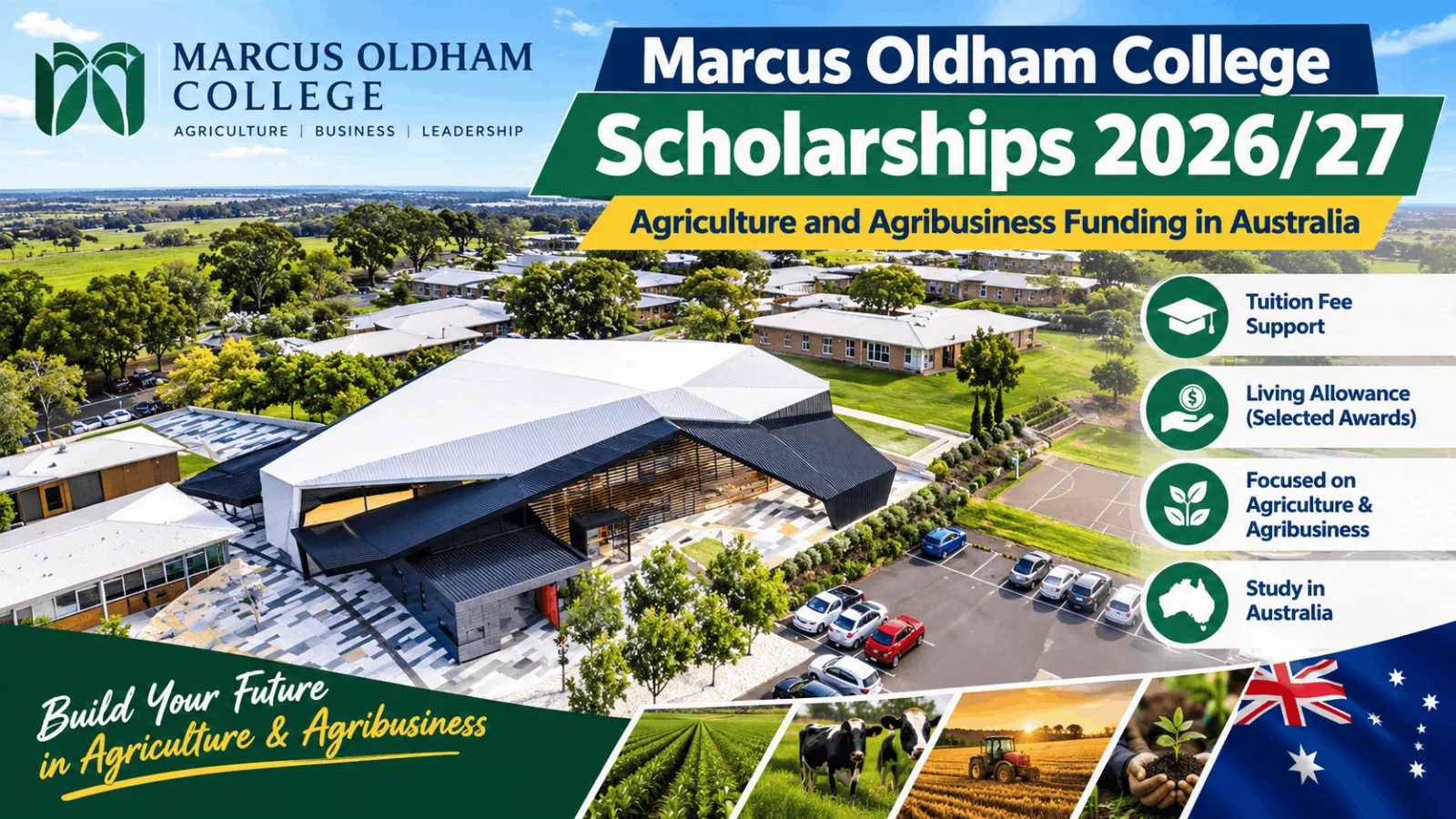
Marcus Oldham College Scholarships 2026/27: Agriculture and Agribusiness Funding in Australia
- Country
- Australia
- Level
- Undergraduate
- Funding
- Partial funding
Marcus Oldham College is a distinctive choice: a small, prestigious Australian college focused entirely on agriculture, agribusiness, and equine business management. Its scholarships are a genuine help toward a specialist education, but they are partial awards, and some favour domestic students, so an honest understanding of what they cover and who they suit matters, especially for international applicants. This guide explains what the college is, what the scholarships really provide, and how to decide whether this niche route is right for you.
What Marcus Oldham is, and why it is different
Marcus Oldham is a small private college in Geelong, Victoria, established in 1962, specialising in agriculture, agribusiness, and equine business management. Unlike a large general university, it offers a focused, hands-on, industry-driven education for people committed to careers in farming, agribusiness, and the horse industry. Its small cohorts, practical approach, and strong rural and agribusiness networks are its defining features. This specialist focus is the key to understanding its scholarships: they are designed to support people genuinely headed into these specific industries, not a broad student population.
What the scholarships actually cover
Marcus Oldham scholarships are partial awards rather than a single fully funded package. In practice they provide:
- Tuition assistance, which can be full or partial on specific awards, reducing course costs.
- Residential or living support on some awards, helping with accommodation and living costs, which matters given the college's residential, hands-on model.
They are often structured as bursaries and merit or commitment-based awards aimed at easing the cost of a specialist education. The honest framing is that they help meaningfully toward the cost but generally do not remove it entirely, so you should budget for the remaining tuition and living expenses. The specific award names and amounts are set by the college and can change, so confirm the current list directly.
Who is eligible
- Applicants who have completed secondary education (Year 12 or equivalent).
- Applicants accepted into a Marcus Oldham programme.
- Applicants showing genuine commitment to agriculture, agribusiness, or equine management.
- Note that some scholarships are restricted to Australian citizens or permanent residents, so international options may be more limited.
Because this is a commitment-driven, specialist college, demonstrated passion for and experience in the field (farm work, agribusiness exposure, equine involvement) genuinely strengthens an application, often more than at a generalist institution.
The honest note for international students
If you are an international applicant, read the eligibility carefully. Some Marcus Oldham scholarships favour or are restricted to domestic students, so the awards open to you may be fewer, and the awards are partial in any case. That does not rule out the college, but it means an international student should confirm exactly which scholarships they can access and budget for Australian international tuition and living costs beyond any award. If you are passionate about agriculture or the equine industry and can fund the balance, Marcus Oldham offers a specialist education and network hard to find elsewhere; if you need full funding, a larger Australian university with research scholarships (or a government scheme) may suit better.
How to apply, step by step
- Confirm the programme fits your goals in agriculture, agribusiness, or equine management.
- Apply for admission to the relevant Marcus Oldham course.
- Identify the scholarships you are eligible for, checking any citizenship restrictions.
- Apply for those scholarships with the required documents and evidence of your commitment to the field.
- Submit before the deadline (which has fallen around mid-year, such as early August), and budget for costs beyond the award.
A realistic timeline
- Before the intake year: gain relevant experience (farm, agribusiness, or equine) that strengthens your case.
- Several months before the deadline: apply for admission and prepare scholarship applications.
- By the deadline (around mid-year): submit scholarship applications with supporting evidence.
- On an offer: plan accommodation (the college is residential) and budget for remaining costs.
- For international students: arrange your student visa and proof of funds.
Why the specialist route can be worth it
For someone certain about a career in agriculture, agribusiness, or the equine industry, a focused college like Marcus Oldham can be more valuable than a generalist degree. Its hands-on model, industry connections, and small, committed cohorts can translate directly into employment and networks in rural and agribusiness sectors, where who you know and what you can practically do matter a great deal. The scholarships, even partial, lower the barrier to that specialist education. The decision comes down to certainty about the field: if you are committed, the depth and network are the real prize; if you are undecided, a broader institution may serve you better.
Common mistakes to avoid
- Expecting a fully funded package. The awards are partial tuition and living assistance.
- Overlooking citizenship restrictions. Some scholarships are limited to Australian citizens or PRs.
- Underestimating costs for internationals. Budget for Australian tuition and living beyond any award.
- Applying without demonstrated commitment. This commitment-driven college values genuine field experience.
- Missing the mid-year deadline. Confirm the current date and apply with time to prepare.
What a strong Marcus Oldham scholarship application shows
Because this is a commitment-driven, specialist college, the applications that succeed look different from a generic university scholarship essay. Selectors want to see that you genuinely belong in agriculture, agribusiness, or the equine industry, so the strongest applications demonstrate:
- Real experience in the field, such as farm work, agribusiness exposure, time in the equine industry, or family or community involvement in agriculture.
- A clear sense of purpose, a specific reason you want this specialist education and what you intend to do with it.
- Fit with the hands-on, residential model, showing you are ready for practical, immersive learning rather than a traditional lecture-based degree.
- Academic readiness, meeting the entry requirements, though commitment and experience often carry particular weight here.
If you can show a genuine, grounded connection to the field, you are exactly the kind of applicant this college and its scholarships are designed for. A generic application that could have been written for any degree is the most common weakness, so lead with your real connection to agriculture or the equine world, backed by concrete examples.
Is this right for you?
Marcus Oldham is ideal if you are genuinely committed to agriculture, agribusiness, or equine management, value a hands-on, industry-connected education, and can fund the portion the partial scholarships do not cover. It is less suited to someone seeking full funding or unsure about the field, or to an international student who finds the open awards too limited. For the right, committed applicant, it is a specialist opportunity with strong industry outcomes that a large university rarely matches.
How to budget around a partial award
Because these are partial scholarships, honest budgeting is part of planning well. Work out the full cost of your Marcus Oldham programme, including tuition and, for the residential model, on-campus living, then subtract the specific award you expect to receive to see the real gap you must cover yourself. For international students in particular, add Australian living costs, a student visa with its proof-of-funds requirement, and health cover, since the open awards may be smaller than those for domestic students. The sensible approach is to treat the scholarship as a meaningful reduction, combine it with any other funding you can secure (family support, industry sponsorship, or savings), and confirm the numbers before committing. Agriculture and agribusiness employers sometimes sponsor students too, so it is worth asking whether an industry connection could help close the gap, since employers in farming, agribusiness, and the equine world value a Marcus Oldham qualification and sometimes back promising students directly.
After graduation
Marcus Oldham's graduates move into farming, agribusiness management, agricultural finance and advisory roles, and the equine industry, supported by the college's strong rural and industry networks. Australia's significant agricultural sector and the global demand for agribusiness skills mean a specialist qualification can open direct career paths, and Australia offers post-study work options for eligible international graduates, subject to current rules. For someone set on this field, the specialist education and connections are a genuine career advantage.
Apply and confirm the details
Check the current scholarships, eligibility (including any citizenship restrictions), and deadlines, and apply, on the official Marcus Oldham College pages: Marcus Oldham College, official site.
Explore more opportunities: browse all our scholarships, prepare for admission with our free IELTS and English prep, or learn how we verify every opportunity.
Disclaimer: OurScholarships is an independent information platform and is not affiliated with or endorsed by Marcus Oldham College. Details change each year and vary by award, so always confirm on the official source before applying.
Frequently asked questions
Are Marcus Oldham College scholarships fully funded?
No. Marcus Oldham scholarships are partial awards: they provide tuition assistance (full or partial on specific awards) and, for some, residential or living support, but they are not a blanket fully funded package covering everything. Many are also bursaries aimed at easing the cost rather than removing it. So read them as meaningful help toward a specialist agricultural education, not a free degree, and budget for the remainder.
What is Marcus Oldham College, and what does it teach?
Marcus Oldham is a small, prestigious private college in Geelong, Victoria, Australia, specialising in agriculture, agribusiness, and equine business management, with a hands-on, industry-driven approach. It is not a large general university; it is a focused institution for people committed to careers in farming, agribusiness, and the horse industry. That specialist focus is central to who its scholarships suit.
Who is eligible, and can international students apply?
Applicants generally need to have completed secondary education (Year 12 or equivalent), gain acceptance into a Marcus Oldham programme, and show genuine commitment to agriculture, agribusiness, or equine management. Some scholarships are restricted to Australian citizens or permanent residents, so international students should check each award's eligibility carefully, as options may be more limited for them.
How do you apply and what is the deadline?
You typically apply for admission to a Marcus Oldham programme and then apply for the relevant scholarships, which have their own criteria and documentation. Deadlines are set by the college and have fallen around mid-year (for example early August) for the following intake. Because specific awards and dates change, confirm the current scholarships and deadlines directly with Marcus Oldham.
Is this scholarship right for an international student?
It can be, but with caveats. Marcus Oldham is an excellent, specialist choice for someone committed to agriculture, agribusiness, or the equine industry, but some scholarships favour domestic students, and the awards are partial, so an international applicant should confirm which awards they can access and budget for Australian tuition and living costs beyond the award. If your passion is agriculture and you can fund the balance, it is a strong niche option.
Why choose a specialist college over a big university?
Because focus and industry connection can matter more than size in agriculture. Marcus Oldham's hands-on, industry-driven model, small cohorts, and strong rural and agribusiness networks can give graduates a direct route into farming, agribusiness, and equine careers. For someone certain about this field, that specialist depth and network can be more valuable than a generalist degree, which is the real case for choosing it.